How to Turn Anonymous Website Traffic Into Pipeline (2026)
Visitor identification gives you a list. Here is the system that turns anonymous website traffic into pipeline: filter to ICP, act while warm, and keep the rest warm.
By Imran Patel, Co-founder and CEO, Syft DataUpdated 8 min read
Turning anonymous website traffic into a pipeline is the promise behind every visitor identification tool, and the honest answer to whether the software does it for you is no. It generates a list.
I have watched plenty of teams buy one of these tools, switch it on, watch the logos light up their dashboard, and then wonder a quarter later why none of it became pipeline. The software did exactly what it promised, and the list was always the easy part.
Pipeline comes from what you do in the hours after a name appears, and that is the part almost nobody designs on purpose. The tool hands you a signal, and whether that signal ever becomes a conversation depends on a chain of decisions sitting entirely on your side.
This is less a guide to buying software and more a guide to building the system around it. I see where the pipeline leaks across our customers, and it is rarely where people expect.
Key takeaways:
- Visitor identification software hands you a list of names. Pipeline comes from the system you build around it.
- Your website works best as a feedback channel on the accounts you already target.
- Speed decides everything. A warm visit acted on within the day beats the same visit worked a week later.
- Watch one number above all: reach, the share of fit accounts showing intent that you actually contact.
Does visitor identification software actually generate leads?
No, and anyone who tells you otherwise is selling you the dashboard. Identification is step one of about five, and on its own it produces a feed of company names, most of which you will never touch. The honest way to picture it is as a funnel that loses people at every stage.
Start with a thousand visitors in a month. Most of them leave without ever filling out a form, and the few who raise their hand are the only ones most teams follow up with at all.
A good tool recovers a chunk of the rest by naming the company, and naming is a long way from qualifying. Of the accounts it names, only some match who you actually sell to, fewer are there with any real intent, and fewer again get reached while that interest is still warm. By the time you get to the people worth a conversation, the thousand has become a dozen.
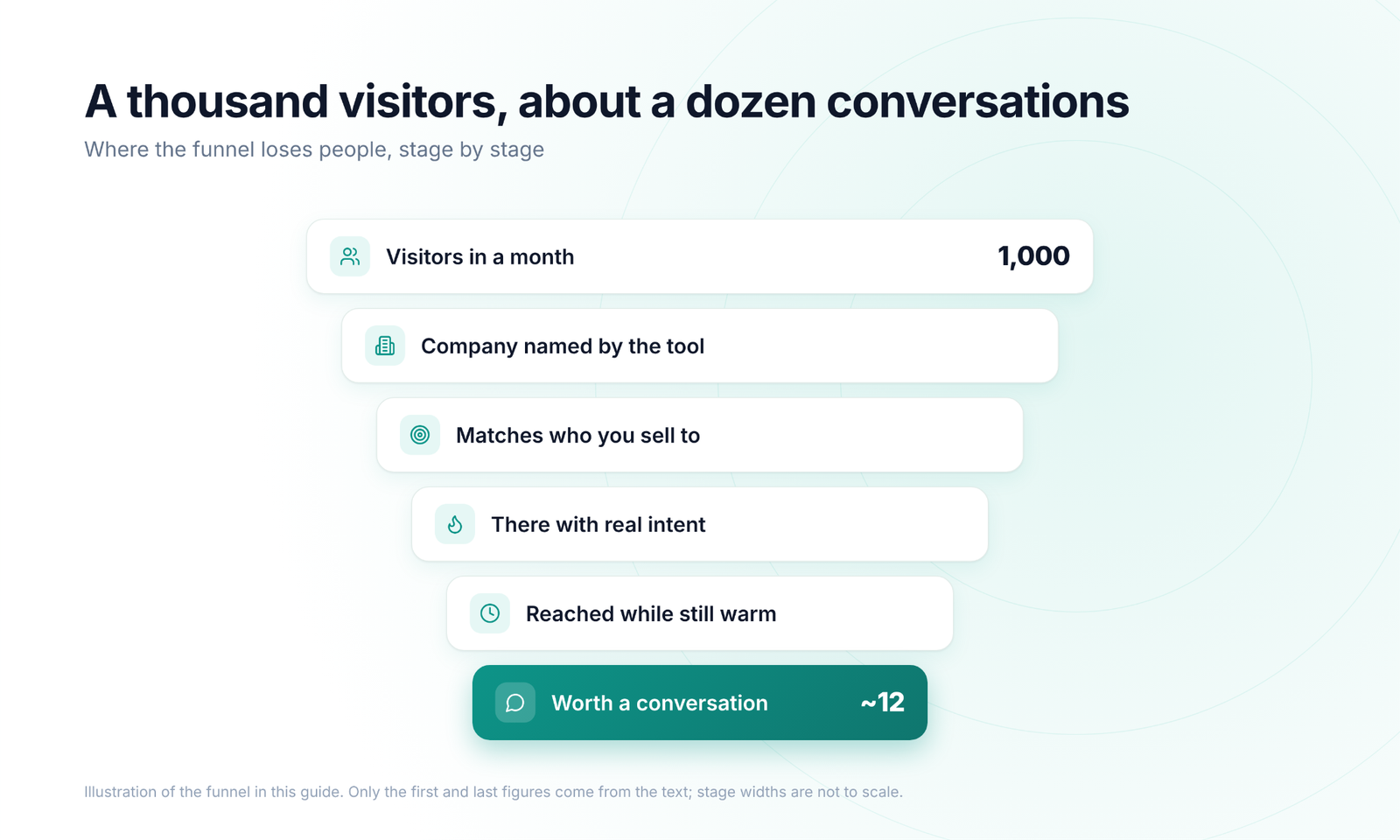
That collapse comes with the work itself, whatever tool you buy. The money is made in how little you leak at each step, and that motion is something you design.
What you can actually learn from anonymous website traffic
One reframe changed how we built our product: your website works best as a feedback channel on the accounts you already chase. Most guides treat anonymous traffic as a pile of strangers to unmask, then hand you a dashboard of charts about devices and bounce rates and cities. That is analytics, and for a sales team it is mostly noise.
The signal worth reading is narrow. It is one of your named target accounts coming back to read your pricing page twice this week. It is a champion who went quiet, turning up again after a job change. You identify traffic to catch the accounts you already decided to chase at the moment they lean in. Everything else on the page is interesting and safe to ignore.
| Worth acting on | Safe to ignore |
|---|---|
| A named target account back on your pricing page twice this week | Overall bounce rate and time on site |
| A quiet champion resurfacing after a job change | Device, browser, and city breakdowns |
| A fit account hitting a high-intent page, then returning | A one-off visit that never comes back |
Once you see the site that way, the job gets smaller and more useful. You stop trying to work through every anonymous visit, and start watching a short list of accounts for a flicker of timing, then acting when you see it.
Step one is the name. Steps two through five are the pipeline.
Between a name on a dashboard and a deal in your CRM sit four jobs, and each one is where teams lose the plot.
| Step | What it is | Where teams lose it |
|---|---|---|
| 2. Filter to ICP | Drop everyone who is not a fit account | Acting on the whole noisy feed |
| 3. Act while warm | Reach the account the same day it shows intent | Batching follow-up into a weekly review |
| 4. The message | Warm, context-led, from a trusted name | Treating a warm channel like a cold one |
| 5. Keep the rest warm | Hold not-ready accounts in retargeting | Blasting them until they tune out |
The first job is filtering to your ICP. A tool that shows you everyone shows you mostly nobody, because the feed fills with customers, competitors, job-seekers and the occasional bot. You want a hard filter that drops all of that and surfaces only accounts that look like the ones you close, ranked by how well they fit and by what they did on the site.
The second, and the one that decides everything, is acting while the interest is warm. An account that hit your pricing page on Tuesday is a different prospect by Friday, and a week later it is cold. Most teams know this and still batch their follow-up into a weekly review, which is where most of the pipeline gets lost. I tell agency owners the same thing: your tools bring the horse to the water, and then nobody makes it drink.
The third is the message, and it pays to be careful here. A warm channel used like a cold one stops being warm. We start follow-up on LinkedIn, where a connection request asks permission before anything else, and we open with context from the visit.
The strongest version has the follow-up coming from a senior name the buyer already half-trusts, the founder or the account's own exec, because trust is the scarce resource in a market where every channel is full of noise.
The fourth is keeping the accounts that are not ready yet. Most fit accounts you identify will not be in a buying window this week, and blasting them anyway is how you teach them to ignore you. The move is to hold them in an account-level retargeting audience, starting on LinkedIn, which keeps you present without being a nuisance and puts you there when the window finally opens.
Visitor ID for B2B marketing: the paid-traffic payoff
If you run paid, this is where identification earns its keep fastest. You are already paying to bring business visitors to the site, and most of that spend gets judged on clicks and cost-per-lead, numbers that tell you nothing about whether a real buyer showed up.
Identify the traffic and the question changes from how many clicks to which accounts, and you can suddenly see that a campaign you were about to kill is pulling in your best-fit logos.
In my experience, paid visitors tend to leave within seconds while organic ones linger, which makes the window to act on a paid campaign even shorter. Paid is also the easiest place to prove the whole idea, because you control the spend and can watch the fit accounts move as you adjust it.
Tonic did this. By reading which ICP accounts their campaigns brought in and cutting the spend that was feeding junk, they reduced wasted ad spend by 27% and reported a 400% return on investment, measured as pipeline against cost. The identification was the input. The result came from acting on it, campaign by campaign.
This is also the honest answer to proving value. You stop reporting impressions to a client who does not care, and start reporting which named accounts your work actually moved.
The one number I would watch
If I could hand a team running this a single metric to live by, I would skip match rate and identified-visitor counts and give them reach: of the fit accounts that showed intent this week, how many did you actually contact? A tool that identifies five hundred accounts and lets you touch ten is worth less than one that surfaces fifty and helps you reach forty, and the review sites will never tell you that, because they are busy counting the five hundred.
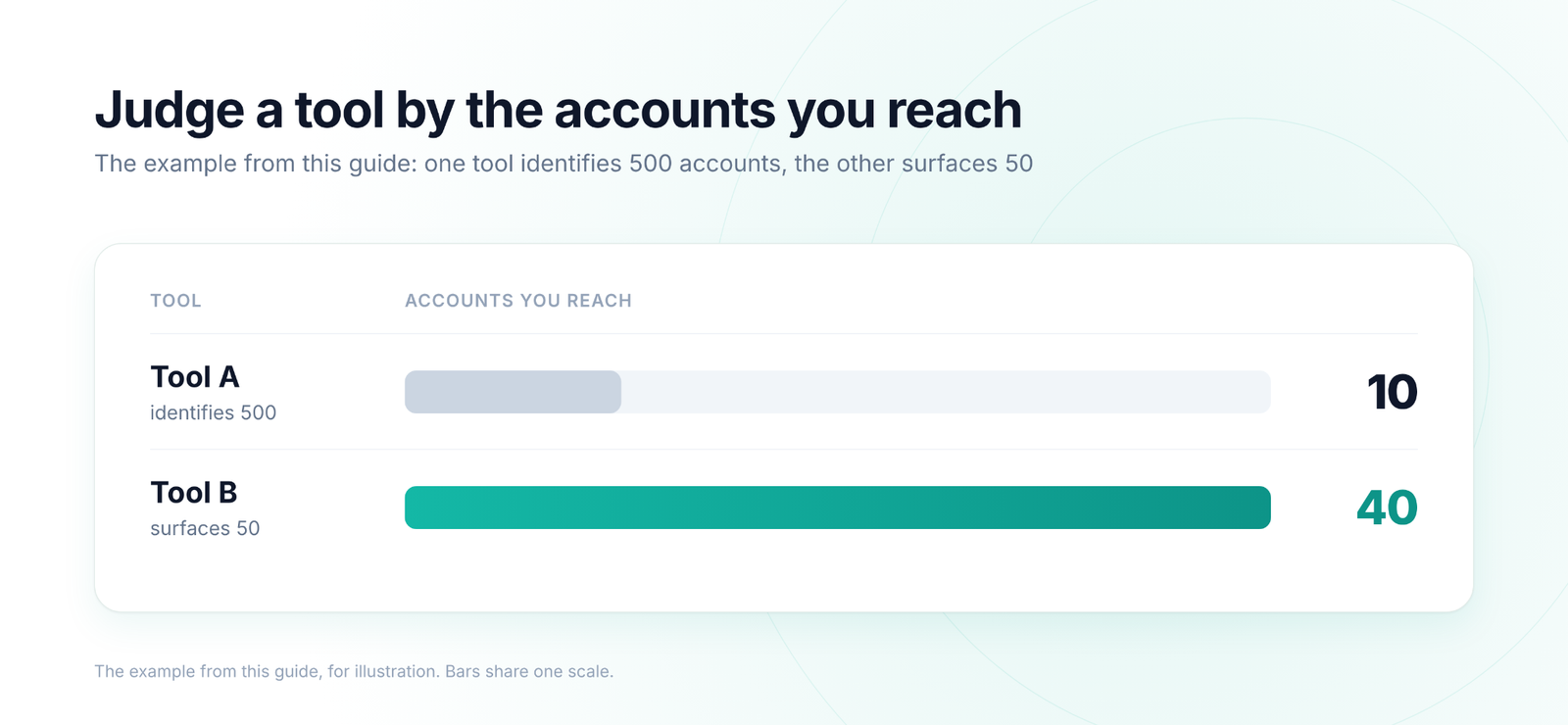
Everything upstream is vanity when reach is low, and almost nothing else matters when it is high. Watch it climb, and the accounts start moving, because you are finally acting on the attention you were already paying for.
Where Syfty fits
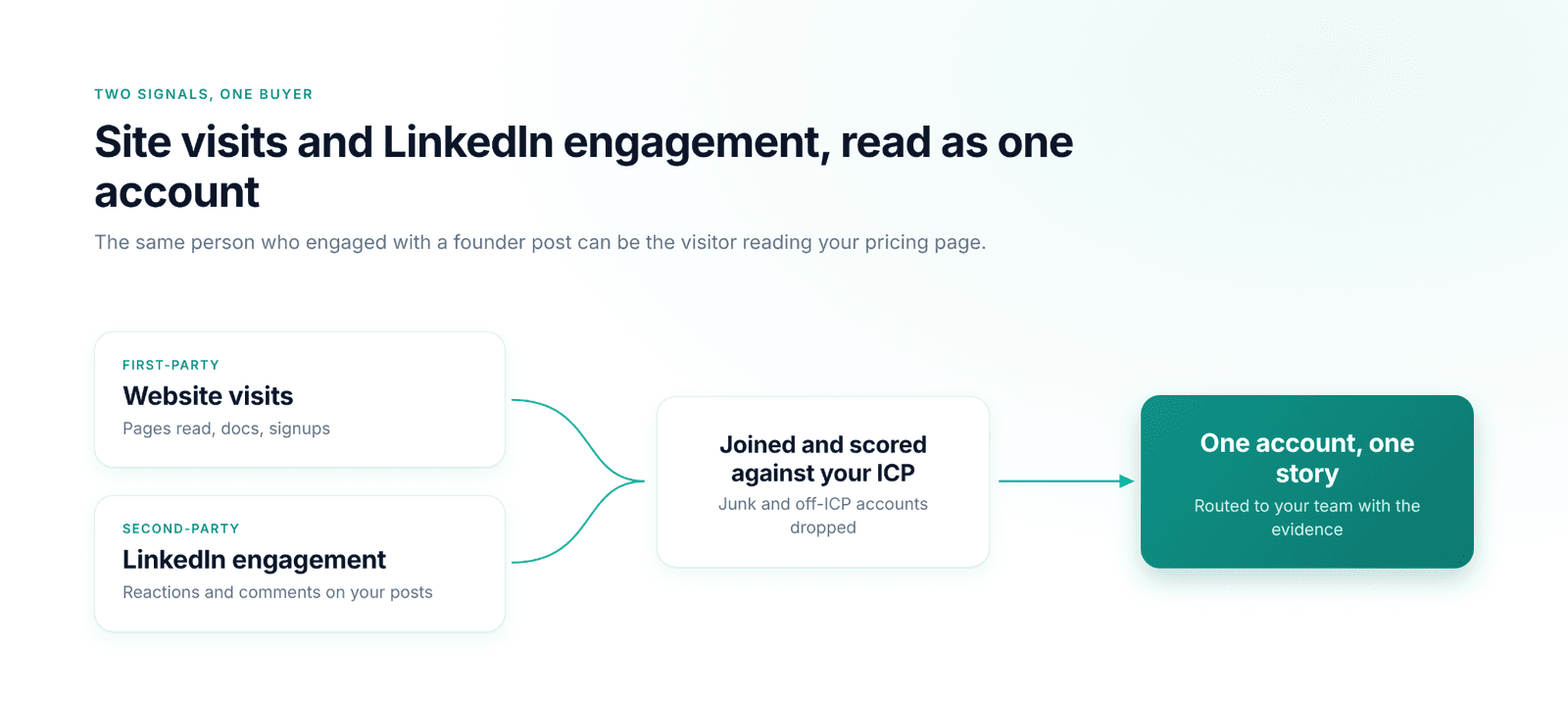
Syfty (formerly Syft Data) is built for the part most tools skip, the motion after the name. It reads the first-party intent on your site and LinkedIn, scores it against your ICP, and then does the work the others leave to you. It routes the fit accounts to a human with the context attached, starts warm follow-up on LinkedIn with an approval step if you want one, and keeps a LinkedIn-ready retargeting list of the accounts that are not ready yet, updated as new signals arrive. The whole design assumes identification is the cheap part and the follow-up decides whether anything moves.
Website identification starts at $150 a month on Starter, and Pro at $500 a month adds LinkedIn intent and outreach. Neither needs a credit card to start, which means you can point it at your own traffic and watch what your current stack has been leaking.
FAQ
How fast do I need to follow up on an identified visitor?
Treat it in hours. The intent that made an account worth contacting fades quickly, so work a visit within the day instead of saving it for a weekly batch.
Can I turn anonymous traffic into pipeline without a big sales team?
Yes, and a small team often does it better, because the whole point is to act on a short list of fit accounts. What you need is a tight filter and a habit of following up quickly, more than headcount. One person who works ten warm accounts well beats five who ignore a hundred.
Is this just retargeting?
Retargeting is one piece of it, the piece that keeps fit accounts warm until they are ready to talk. The rest is identifying the right accounts in the first place and acting on the ones showing intent right now, which retargeting on its own will never do for you.