Best B2B Website Visitor Identification Software (2026)
A ranked guide to the best B2B website visitor identification software in 2026, with live pricing, a hard look at accuracy and coverage, and who each tool is for.
By Imran Patel, Co-founder and CEO, Syft DataUpdated 12 min read
Every piece of website visitor identification software on this page will tell you, with complete confidence, which company just visited your B2B site. Most of the time it's wrong, though, and the whole category has quietly agreed to sell you on coverage so that nobody has to talk about accuracy.
The pattern underneath all of them is the same. A single data source only ever catches part of your audience, and it gets a share of that part wrong, which is why the better tools now stack several sources and reconcile them against each other. Agreement between sources, more than any one vendor's confidence, is what predicts a right answer.
That's why coverage, the big number every vendor splashes across its homepage, means so little on its own. They lead with it because it sounds impressive, and because the accuracy figure sitting behind it would embarrass most of them.
Read this list with one question in mind: which of these answers can you trust enough to act on? What you do with a confirmed buyer, and whether a lean team can run the thing without a RevOps hire, follows from there, and that's how we ranked the ten below.
Quick picks:
- Confirmed buyers, lean teams: Syfty (formerly Syft Data), from $150/mo.
- Best free company-level plan: Leadfeeder Lite, free forever.
- US person-level outbound: RB2B, from $79/mo.
- Cheapest serious company data: Snitcher, from $49/mo.
- European company data: Leadinfo, from €69/mo.
- Enterprise ABM with predictive intent: 6sense, if you have the budget.
Why most "match rates" are fiction
Before you compare a single vendor, understand that a "match rate" can mean three different things: the share of visits, the share of unique visitors, or the share of companies. On the same traffic, those three can land far apart, and vendors naturally quote whichever one flatters them while leaving the denominator off the page.
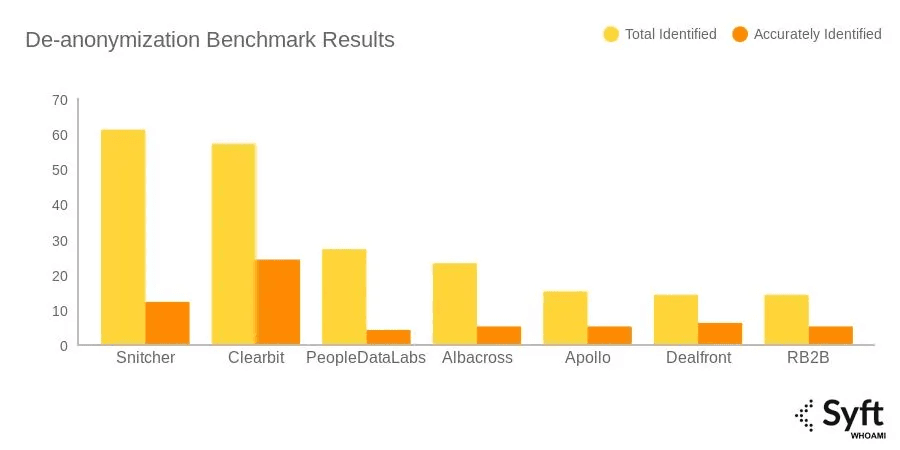
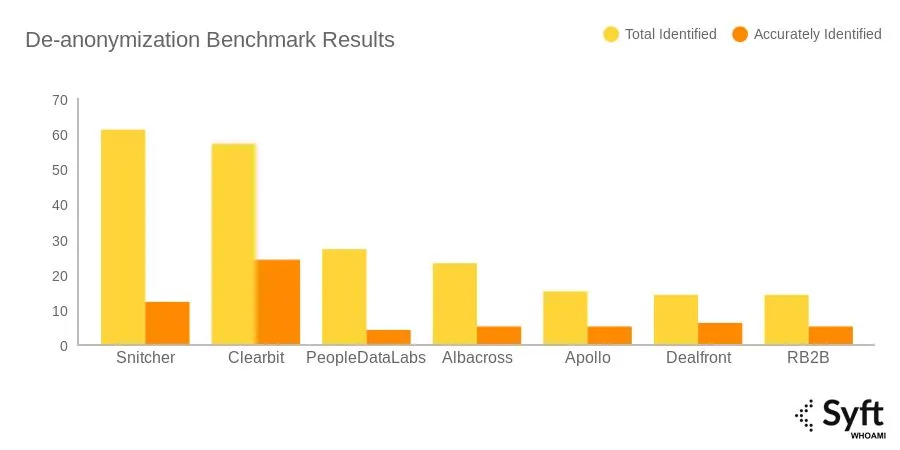
Our 2024 visitor identification benchmark put hard numbers on the gap. Snitcher put a company name on roughly six in ten visitors, and one in five of those names was right. Coverage counts how often a tool answers. Accuracy counts how often it is right, and the two rarely move together.
Share of visitors each tool identified (yellow) and identified correctly (orange).
Person-level gets rougher still, since the tool has to name the right individual on top of the right company.
None of this makes identification useless, but it changes how you hold it: you treat a single match as a lead worth checking and believe it far more once a second source agrees, and that one habit serves you better than any coverage figure a homepage can throw at you.
The ten tools at a glance
| Tool | Best for | Signals | ID level | Pricing (verified Nov 2026) | Runs without RevOps? |
|---|---|---|---|---|---|
| Syfty (formerly Syft Data) | Confirmed buyers, lean teams | Site and LinkedIn | Company + LinkedIn engagers | From $150 / mo | Yes |
| Leadfeeder (Dealfront) | Companies into your CRM | Site only | Company | Free; from €79 / mo (annual) | Mostly |
| RB2B | Fast US person-level names | Site only | Person (US) + company | Free; from $79 / mo | Yes |
| Warmly | Real-time on-site engagement | Site only | Person + company | From $10,000 / yr | No |
| Factors | Intent + ABM journeys | Site only | Company + intent | From $199 / mo | Mostly |
| 6sense | Enterprise ABM, predictive | Site + third-party intent | Account + intent | Custom | No |
| Albacross | Budget EU, Pipedrive teams | Site only | Company | From €59 / mo (annual) | Mostly |
| Lead Forensics | Managed, sales-led rollout | Site only | Company | Quote only | Mostly |
| Snitcher | CRM integrations on every plan | Site only | Company | From $49 / mo | Yes |
| Leadinfo | European company data | Site only | Company | From €69 / mo | Yes |
Every price here was checked against the vendor's own pricing page in November 2026, and since most of them scale with traffic, your real bill will track your own volume.
1. Syfty (formerly Syft Data)
Syfty sits at the top of this list because it's built around the finding the rest of the category would rather not mention: if one provider's guess is a coin flip, the sane response is to stop trusting one.
It runs several providers at once, reconciles their answers against each other, and scores whatever survives against the exact companies and roles you sell to, which is how a pile of maybes turns into a short list of accounts you can believe.
That reconciled waterfall is the approach our 2024 visitor identification benchmark points to: when independent sources name the same company for a visitor, that answer tends to be right. What separates Syfty, though, is that it watches your LinkedIn too, which means the person who engaged with your founder's post on Monday and read your pricing page on Thursday arrives in your CRM as one human with one story instead of two anonymous visits you'd never have connected.
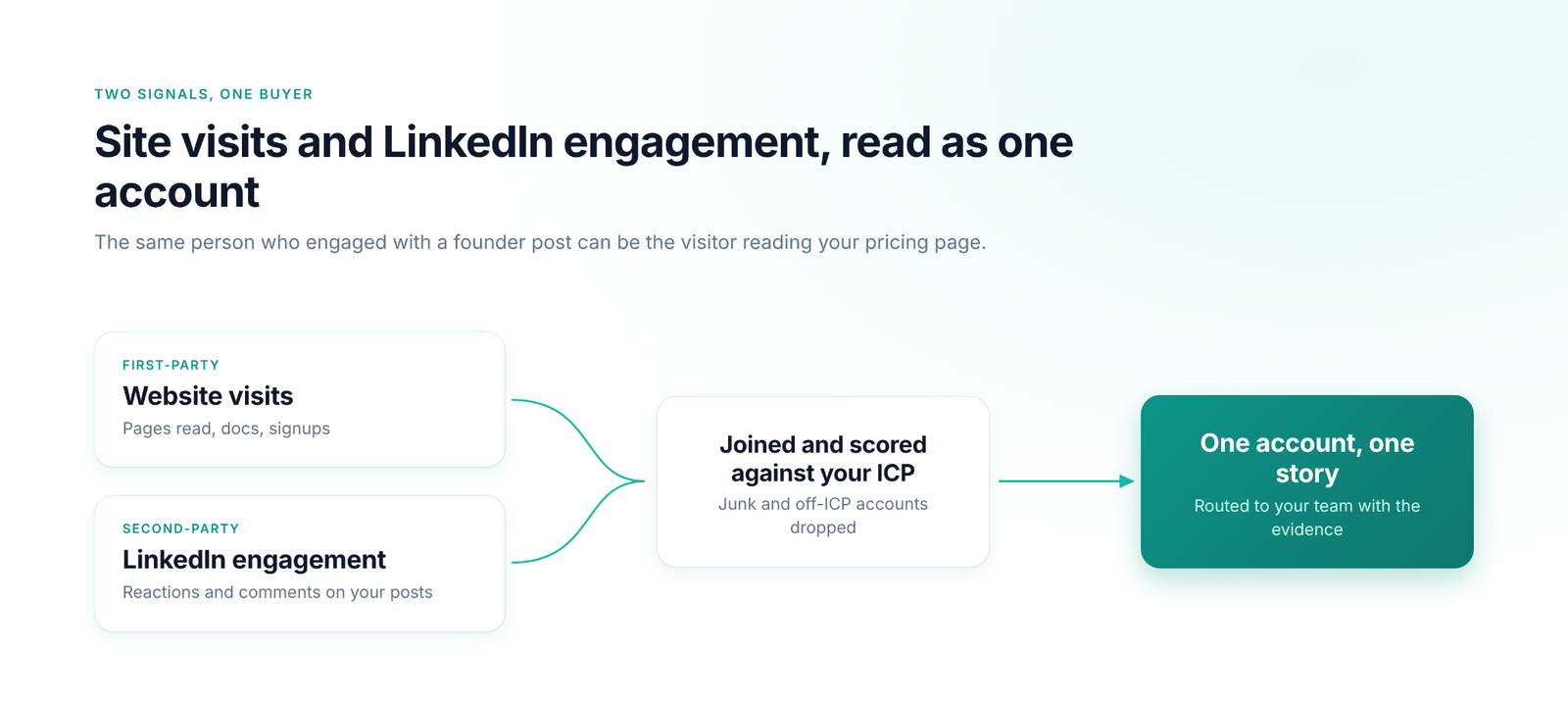
The thinking underneath it is that your website does its best work as a feedback channel, a stream of first-party intent on the demand you already created, and the job is to confirm the real buyers hiding in that attention and hand them to sales while they're still warm.
Pricing: website identification on the Syft Data platform starts at $150/mo on Starter, with LinkedIn intent on Pro at $500/mo, both billed annually ($188 and $625 month to month). The Syfty LinkedIn agent runs $99/mo for one founder profile, or $625/mo on Pro, which joins your website visits to your LinkedIn engagers, both free for 30 days.
Skip it if: your site barely gets traffic, or you need guaranteed person-level names outside the US, which no tool here can promise.
2. Leadfeeder (Dealfront)
Leadfeeder is the dependable veteran of the company-level crowd, recently back under its own name after a spell as Dealfront, and if your buyers sit in Europe its data depth and GDPR footing are about the best you'll find here. It works at the company level: it'll tell you Acme stopped by without ever telling you who at Acme did, and the contacts it offers come from a database match rather than the visit itself.
For an account-based team that mostly wants European companies flowing into a CRM, it makes a safe default, and the free Lite tier is one of the few in this category you can run on while you make up your mind.
Pricing: free Lite (the last 100 companies a month); Discover from €79/mo on annual billing, rising to Scale at €599, with a 14-day trial and no card.
Skip it if: you need individual names, or your traffic skews remote and consumer-ISP, where any IP-based tool starts to struggle.
3. RB2B
RB2B is the tool that turned person-level identification into a household idea for outbound teams, because the moment someone lands on your site, it drops their name and LinkedIn profile straight into Slack, and for a US team that moves fast, that trigger is useful.
It's also the clearest reason to stay skeptical about everything else on this page. Every name it hands you is a probabilistic match, and without a filter your Slack fills with recruiters, students, and the occasional plumber. A name tempts you to reach out, and a warm message to the wrong person is the quickest way to teach your buyers to ignore you.
Pricing: free (150 resolutions, company-level only); Starter $79/mo, with emails and CRM sync arriving on Pro from $149/mo.
Skip it if: your buyers sit outside the US, or you won't run it behind an ICP filter.
4. Warmly
Warmly's whole pitch is immediacy. It identifies visitors and lets you pounce while they're still on the page, through AI chat, live video, and instant booking, which suits a certain kind of inbound-heavy sales team.
That orchestration is powerful, it's expensive, and it wants a human tending it. Plans open at ten thousand a year, the headline add-ons run another ten thousand each, and the whole thing is a lot of machine for a thirty-person team with nobody owning RevOps. HubSpot also agreed to acquire it in June 2026, and the roadmap is worth reading before you sign up for a year.
Pricing: from $10,000/yr, billed annually or quarterly, with no free tier.
Skip it if: you're a small team, or you live outside the HubSpot and Salesforce world.
5. Factors
Factors is an account-based marketing analytics platform that happens to do visitor identification along the way, stitching the whole account journey together across your ads, your site, and your CRM stages. If you want that full path in one view, it's a strong fit, with identification as the means to that end.
Hold its headline at arm's length. The pricing page promises to unmask "over 75% companies visiting your website," the sort of figure-with-a-hidden-denominator this whole page keeps warning you about. Run it on your own traffic before you take the number at face value.
Pricing: Lite at $199/mo; Basic at $6,000/yr adds CRM sync, with Growth and Enterprise climbing from there.
Skip it if: you only want visitor identification and have no use for the ABM analytics wrapped around it.
6. 6sense
6sense plays an entirely different game from the rest of this list. It's a full enterprise ABM and predictive-intent platform where visitor identification is only one layer, and its main strength is flagging accounts that are in-market before they ever reach your site, which earns the investment for a team running a serious account-based program with the people to operate it.
For everyone else, it's overkill. You're signing up for enterprise pricing, a real implementation project, and a signal that works at the account level, which tells you a company is interested and leaves you to work out which human to call.
Pricing: custom, enterprise contracts.
Skip it if: you're a lean team that just wants to know who visited and has no appetite for running a predictive ABM platform.
7. Albacross
Albacross is a Swedish company-level tool with strong coverage across European traffic, and it's the friendliest entry point for a Pipedrive team, since the Pipedrive integration comes bundled into the Starter tier instead of being locked away higher up.
The thing to weigh, true of every tool here, is geography. Accuracy swings hard with where your visitors sit, and a vendor that looks brilliant on US corporate traffic can come back almost empty on another region. Run it on your own traffic before you trust anyone's coverage map.
Pricing: from €59/mo on annual billing (€84 monthly), with HubSpot gated behind Professional and Salesforce behind the quote-only Organisation plan.
Skip it if: you're on HubSpot or Salesforce and don't fancy paying up a tier just to connect your CRM.
8. Lead Forensics
Lead Forensics has been doing this longer than almost anyone, with a large proprietary IP database and a sales-led, managed model. A UK or European enterprise team that wants a managed rollout and a dedicated account manager will get on well with it.
The trade-off is a demo-first buying process with no public pricing, and an interface that looks dated next to the newer tools on this list.
Pricing: quote only, scaled to your traffic and the leads it surfaces.
Skip it if: you want self-serve, transparent pricing, or you're a small team that needs to move quickly.
9. Snitcher
Snitcher is the value pick, and a strong one, because it keeps its core integrations on every plan instead of gating them behind higher tiers.
HubSpot, Salesforce, Pipedrive, Slack and a full REST API come on every plan with no seat fees, though CRM sync is manual on Starter, and GA4 is available as a $49/mo add-on. It runs on a single company-level database, which is your cue to lean on it hardest once a repeat visit backs up the match.
Pricing: from $49/mo, with 35% off on annual billing and a 14-day trial with no card.
Skip it if: you need person-level names, or you want outreach and enrichment built in rather than bolted on.
10. Leadinfo
Leadinfo is the clean European option, with particularly strong data across the Benelux and DACH regions, and it absorbed Canada's Visitor Queue in January 2026, which brought it a North American customer base. It pairs company identification with a decision-maker database, which gives you someone to follow up with for every company it names.
It carries the same company-level ceiling as the others, and the same rule applies here too: a single call is worth more the moment a second signal agrees with it.
Pricing: Starter from €69/mo, with automated CRM sync on Scale (€159) and Pro (€359).
Skip it if: your traffic is mostly US, or you need to identify individuals rather than companies.
What changed in the last few years
The category has consolidated fast. HubSpot bought Clearbit at the end of 2023 and folded it into Breeze, Koala shut down in September 2025 after Cursor acquired it, and Leadinfo absorbed Visitor Queue in January 2026.
Dealfront went back to the Leadfeeder name in March 2026, HubSpot agreed to acquire Warmly at the end of June, and Zoom agreed to buy Common Room two days later. Trigify's team joined HubSpot too, and the standalone product has been wound down.
If a "best tools" list you're reading still presents any of those as living, independent products, it hasn't been touched in months.
How to choose
Three questions get you from ten tools to a real shortlist.
Start with whether you need the company or the person. Company-level identification suits account-based prioritization and works in every region, with accuracy that varies by region, while person-level is built for direct outreach and holds up reliably only on US traffic, which means it belongs in your workflow only behind a tight ICP filter.
Then think about where your traffic comes from, because accuracy shifts with both region and device, and mobile visitors are the hardest of all to pin down. Whatever a vendor promises you, the only match rate that means anything is the one you measure on your own site.
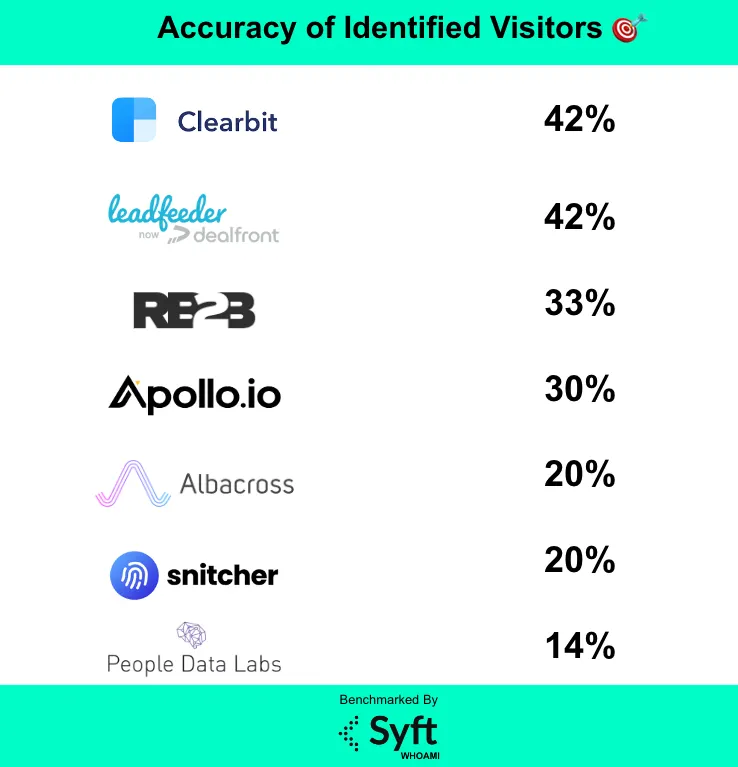
Share of each tool's identifications that named the right company.
The question most buyers skip is whether you want data or data you can act on. Naming a visitor is the easy part, and the account only moves once you prioritize it, enrich it, route it to a human and keep it warm, and a tool that stops at a pretty dashboard hands you the hardest part of the job.
Once you've worked through those, run your shortlist on your own traffic and count the companies you'd pick up the phone for.
FAQ
How accurate is visitor identification, really?
A single source only sees part of your audience and gets some of it wrong, which is why an identification tends to be accurate once several independent sources agree on the same company. In our 2024 benchmark, even the most precise tools named the right company for about four in ten of the visitors they identified. Whatever the homepage claims, test it on your own traffic before you believe it.
How is this different from Google Analytics?
Analytics can tell you that a session happened, how long it lasted and where it came from, while visitor identification tells you which company, and sometimes which person, was behind that session. They answer two different questions and work best sitting side by side.
Is it GDPR compliant?
It can be, depending on the tool and how you use it, since company-level identification usually runs on legitimate interest and carries less risk than naming individuals, which in the EU generally needs consent. Whether that reasoning holds for your particular setup is a conversation for your legal counsel.